Reinventing office coffee breaks with healthier and tastier snacks that boost focus
In most offices, the “coffee break” looks exactly the same: queue at the machine, grab a biscuit, complain about emails, go back to your desk slightly wired and already thinking about the next coffee. Familiar, yes. Effective, not really.
What if that 10-minute ritual could actually improve focus, stabilise energy, and make people happier to be at work – without turning your office into a wellness retreat or a start-up cliché with kombucha taps everywhere?
Let’s look at what really happens during a coffee break, why the usual snacks are working against you, and how to redesign this micro-moment in the workday with healthier, tastier options that genuinely support concentration.
The real cost of the classic coffee break
In the UK, office workers drink an average of 2–3 cups of coffee a day, often paired with something sweet: biscuits, pastries, chocolate bars. It feels harmless. It’s not.
That combo – caffeine + fast sugar + ultra-processed fats – has a predictable effect:
Studies regularly link high consumption of ultra-processed foods with reduced cognitive performance and increased fatigue. One large cohort study in 2022 (published in Neurology) even suggested that high intake of ultra-processed foods was associated with faster cognitive decline in adults.
Translate that to an office day: those biscuits and sugary lattes are not just “little treats”; they’re helping create the classic 3 p.m. productivity crash – the moment where Slack goes quiet, eyes get heavy, and the to-do list stops moving.
From an employer perspective, this matters. Coffee breaks are already paid time. If they regularly end in a focus crash, you have a silent productivity leak baked into your daily routine.
What a “focus-friendly” coffee break actually looks like
Forget the Instagram wellness fantasies. A better coffee break doesn’t require matcha ceremonies or macro-counting. It boils down to three principles:
On the physiological side, what really helps focus is quite simple:
Caffeine itself is not the enemy. Several studies show that moderate consumption (up to about 3–4 coffees a day for most adults) can improve alertness and reaction time. The problem is what you add to your coffee, and what you eat with it.
So, the question becomes: how do you build a snack offer around coffee that keeps the pleasure but removes the crash?
Swapping biscuits: realistic alternatives that people actually eat
The most common objection when companies try to “healthify” their snacks is brutally honest: “Yes, but will people actually eat this?” If your team sees a sad bowl of unsalted almonds replacing their favourite cookies, they will simply… bring their own cookies.
The goal is not punishment. The goal is better defaults. Here are options that pass three tests: tasty, practical, office-proof.
Instead of: industrial biscuits and chocolate bars
Try:
Result: the fat + fibre combo slows digestion, avoiding the sugar spike. Dark chocolate still delivers that “treat” feeling.
Instead of: sugary yogurts and flavoured milks
Try:
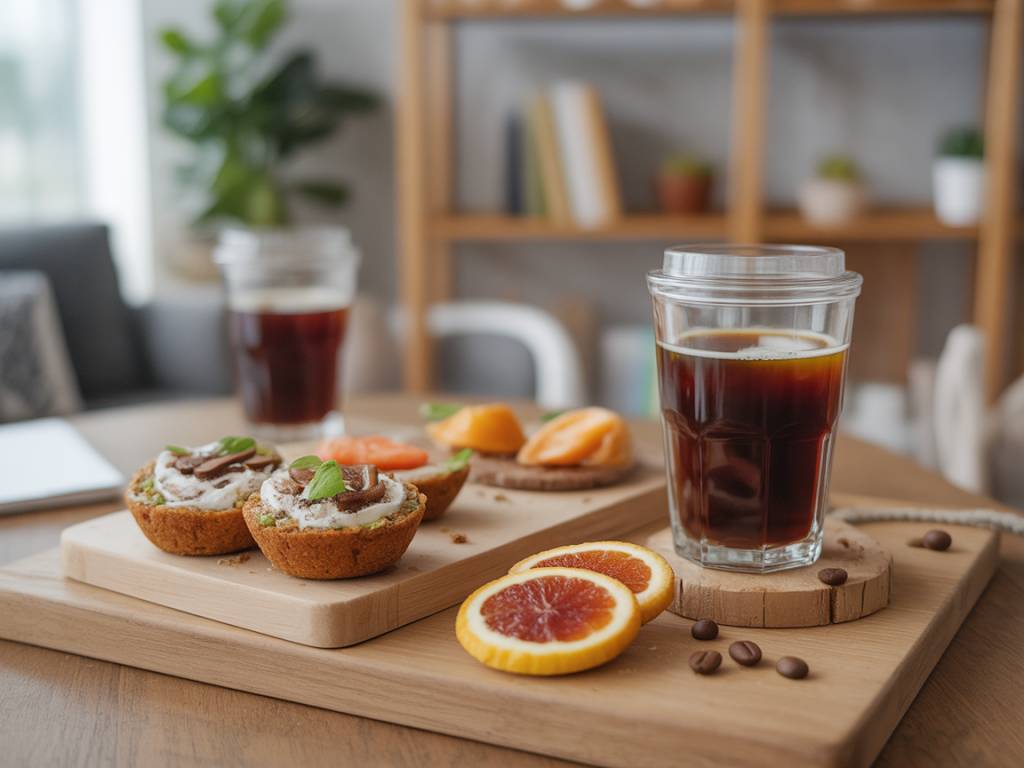
Result: protein and probiotics, less sugar, more satiety. And if you let people customise with toppings, you add a small “ritual” factor that makes the break more satisfying.
Instead of: muffins, croissants and pastries every morning
Try alternating with:
Result: you keep the “morning treat” culture but cut down on refined flour and saturated fat. Rotating options avoids the “diet regime” perception.
What to pair with coffee (and when to skip it)
Not all coffee breaks are equal. The 10 a.m. espresso does not play the same role as the 4 p.m. “I’m exhausted” latte. You can adapt what you offer accordingly.
Morning break (9–11 a.m.)
Objective: support alertness until lunch without overloading on sugar. Good pairings:
This combo stabilises blood sugar and prevents the “I’m starving at 11:30” effect.
Afternoon break (2–4 p.m.)
Objective: boost focus without ruining sleep or creating a post-5 p.m. crash.
If you want to be radical, try a “no coffee after 3 p.m.” internal challenge for a week, and track how people sleep and perform. The feedback is often surprising: the short-term discomfort is offset by better sleep and less “brain fog” the next day.
Brain-friendly nutrients hiding in plain sight
You don’t need supplements to support focus. A few classic foods, integrated in the break routine, can already make a difference.
Integrating them doesn’t require a culinary revolution. It can be as simple as:
Designing the break space: environment matters as much as the menu
Even the best snacks won’t fix a break that doesn’t feel like… a break. If the coffee machine is wedged between a noisy printer and a pile of archive boxes, people will grab and run. That’s bad for recovery and for informal communication.
Several workplace studies point in the same direction: micro-breaks that allow a real change in posture and environment (standing up, moving, brief social interaction) are associated with better perceived focus and lower fatigue.
So, ask yourself:
Small, low-cost changes can already transform the experience:
The goal is not to build a café, but a signal: “Here, you can pause. And we’ve thought about what will actually help you when you go back to your tasks.”
How to get your team on board (without sounding like a food cop)
Culture is often a bigger obstacle than budget. If the office mantra is “We deserve a donut, the day is hard”, any attempt to improve snack quality may be interpreted as moralising or cost-cutting.
Two keys: co-creation and transparency.
1. Ask before changing everything
A simple internal survey goes a long way. Ask questions such as:
Then share the results, and build your new snack offer accordingly. If people see their feedback reflected, they’re far more likely to play the game.
2. Explain the “why”, not just the “what”
Instead of “We’re removing biscuits”, try:
This frames the change as a productivity and well-being experiment, not a moral judgement on sugar.
3. Keep some treats – strategically
You don’t need to go 100% “clean eating”. In fact, it’s often counter-productive. A good compromise:
For example, a “Friday treats” box with pastries or chocolate that appears once a week rather than every day. People enjoy it more, and it stops being an automatic reflex.
Practical roadmap to reinvent coffee breaks in your office
If you’re responsible for an office (HR, office manager, team lead), here’s a concrete, staged approach you can implement over four to six weeks.
Step 1: Audit what’s really happening now
Step 2: Set simple, measurable goals
These goals help you talk about the project in concrete terms, not vague “healthier culture” language.
Step 3: Curate a new snack selection
Build it with three categories:
Negotiate with your suppliers. Many office food providers now have “healthy snack” catalogues – but check labels, not just marketing.
Step 4: Redesign the break message
You don’t have to renovate the kitchen. But you can change the story around breaks.
Step 5: Test, measure, adjust
After a month, survey again.
Adjust quantities and selection. Maybe your team loves Greek yogurt but ignores veggie sticks. Fine – double down on what works instead of forcing what doesn’t.
What about remote or hybrid teams?
If your teams are not all in the same building, you can still rethink the “coffee break” as a shared ritual.
The objective stays the same: transform the coffee break from “scrolling social media alone with a sugar bomb” to “short reset that genuinely supports the rest of the workday”. Whether that happens in an office kitchen or at a home desk is secondary.
From ritual to performance tool
Reinventing office coffee breaks is not about policing what adults eat. It’s about acknowledging an obvious truth: these 10-minute pauses structure the day, influence energy levels, and shape the social fabric of a team.
You can either leave them in the hands of vending machines and habit… or treat them as a strategic lever for focus, morale, and even employer branding.
A well-designed break, with the right snacks and the right environment, ticks several boxes at once:
Next time you’re waiting for your coffee to pour, look around: what’s within arm’s reach? A packet of biscuits… or a quiet, efficient upgrade to how your entire team thinks and feels for the rest of the day?
À propos de l'auteur