Tips for organising a minimalist home without sacrificing comfort, warmth and personality
You don’t have to live in a white box with one chair and a sad ficus to call your home “minimalist”. If anything, that cliché explains why a lot of people abandon minimalism before they even start: they associate it with coldness, stiffness, and a life where you’re afraid to put a cup down on the table.
The real question is different: how do you strip away the excess without stripping away comfort, warmth and personality? That’s what we’re going to unpack here, with a focus on what you can appliquer dès ce soir – not in some hypothetical new house with designer furniture.
Minimalism isn’t about less stuff. It’s about less friction.
When people say “I want a more minimalist home”, they often mean:
- “I’m tired of visual chaos and things I don’t use.”
- “I want rooms that are easy to clean and relaxing to be in.”
- “I don’t want to feel guilty every time I look at that unused treadmill / blender / decorative ladder.”
Minimalism, in practice, is just a way to reduce friction in your daily life:
- Less time cleaning = more time resting or seeing people.
- Less visual noise = easier to focus and unwind.
- Less accumulation “just in case” = less guilt and mental charge.
The problem is that a lot of minimalist inspiration online is staged for photos, not for living. Sofas with no cushions, coffee tables with nothing on them, kitchens that look unused. It’s easy to copy the look and then realise you’ve accidentally designed a waiting room.
The goal here is different: a home that feels calm to the eye, but warm to the body and brain. To get there, you start with your needs, not with Pinterest.
Define what “comfort” means to you before you declutter
Minimalism that ignores comfort won’t last more than a weekend. So before you fill donation bags, you need a baseline: what does a “comfortable” home mean in your case?
Take 10 minutes and, room by room, ask yourself:
- What activities actually happen here? (Work? TV? Reading? Kids’ games? Yoga?)
- What has to be within arm’s reach for these activities? (Blanket? Notebook? Remote? Toys?)
- What annoys me regularly in this room? (Not enough light? Nowhere to put your mug? Always tripping over cables?)
Write it down. It sounds obvious, but this list becomes your anti-minimalism shield: if something clearly supports an activity you care about, it stays. If it doesn’t, it’s a candidate for leaving.
Example, living room:
- Activities: reading, watching films, occasional remote work, guests on weekends.
- Must-haves within reach: two throws, side table for drinks, a lamp behind the sofa, a basket for remotes and chargers.
- Pain points: bookshelf overflowing, coffee table always covered in random objects.
From there, your goal isn’t “how do I make this room look empty?” but “how do I make these activities easier and the pain points disappear?” That mental shift is what keeps your home both minimalist and liveable.
Declutter with boundaries, not with guilt
Minimalism often fails because it’s treated like a moral competition: the fewer things you own, the more virtuous you are. That’s a recipe for regret and rebound shopping.
Instead, use physical boundaries and simple rules.
1. Set space limits instead of arbitrary numbers
- Books: “Everything must fit in this one bookcase. If it doesn’t, something has to go.”
- Clothes: “All my everyday clothes must fit in these X drawers and this section of hanging space.”
- Kitchen gadgets: “Only what fits comfortably in these two cupboards stays.”
The space decides, not your mood.
2. Sort by function, not by category only
Rather than “all decorative objects”, ask “what adds comfort, warmth or utility?”
- The lamp you switch on every evening? It stays.
- The third vase you only use when you remember it exists? It probably goes.
3. Create a “probation box”
For items you’re unsure about, use a labelled box with a date three months from now. If you don’t open it in three months, donate or sell. This reduces decision fatigue and the “what if I need it?” anxiety.
The key: you’re not punishing yourself for owning things; you’re editing your belongings so they actively support your daily life.
Use materials, textures and colour to keep the warmth
Most people who say “minimalism is cold” aren’t reacting to the lack of objects but to the dominance of hard, flat, cold surfaces: glass, metal, stark white walls, glossy finishes.
You can have fewer objects and still create a warm atmosphere with three levers: texture, natural materials, and a controlled colour palette.
1. Add texture where you sit and touch
- Replace or cover a shiny synthetic rug with a woven wool or cotton rug.
- Add one or two quality cushions with different textures (linen, bouclé, velvet) instead of five similar cheap ones.
- Use a heavy throw or blanket on the sofa in a tactile fabric (knit, waffle, faux fur).
Same number of items, but more sensory comfort.
2. Prioritise natural or “quiet” materials
- Wood (even veneer) for tables, shelves, frames.
- Ceramic, stoneware or glass instead of plastic for the most visible everyday objects (vases, soap dispensers, storage jars).
- Cotton or linen for bed linen and curtains.
These materials age better visually and create a perception of warmth, even in a pared-down space.
3. Calm the colour palette, don’t sterilise it
You don’t have to go full white-and-beige. The idea is to reduce contrast, not erase personality:
- Pick a base of 2–3 neutrals (white, off-white, grey, sand, greige).
- Add 1–2 accent colours you genuinely wear or gravitate towards (forest green, rust, navy, terracotta…).
- Repeat them in several places: cushions, a throw, one or two art pieces, maybe the spine colours of the books you decide to display.
This gives coherence without making the room feel like a showroom. A minimalist home can absolutely have a deep green armchair or mustard cushions – as long as they’re not competing with ten other colours.
Design the layout around comfort, not the walls
Another reason minimalist interiors feel cold: everything is pushed against the walls, like in a conference room. You walk into a big empty square and feel observed rather than welcomed.
Try rearranging furniture with two questions in mind:
- Where do I want people to naturally gather?
- Where do I want to feel “held” rather than exposed?
1. Create islands, not perimeters
- Pull the sofa slightly away from the wall and anchor it with a rug.
- Place the coffee table so you can easily reach it without stretching.
- Add a small side table near the armchair for a lamp and a mug.
Everything still stays minimal – one sofa, one table, one lamp – but their position creates intimacy.
2. Keep clear paths
A minimalist home should be easy to move in. If you constantly sidestep a chair or basket, the layout is wrong.
- Leave at least 60 cm for walkways between furniture.
- Avoid placing low objects where you naturally cut corners.
Minimalism is not about empty rooms; it’s about rooms that don’t fight your movements.
Hide the chaos, not your personality
Visual calm doesn’t mean you have to hide everything that says something about you. The trick is to separate collections from clutter.
1. Curate a few “story” items
Instead of 20 random souvenirs on every surface, choose a few that actually carry weight:
- A framed photo from a trip that changed something for you.
- One object with a story (a bowl from your grandmother, a stone from a specific hike, a piece of local craft).
- A favourite book, vinyl or magazine left out on purpose.
Display them intentionally, with breathing room around them. They stand out more and say more about you than a crowd of knick-knacks.
2. Use closed storage for everything that doesn’t need to be seen
- Boxes or baskets in a TV unit for cables, chargers, controllers.
- Closed cupboards for documents and admin, with one tray or vertical file on the desk for current tasks only.
- Lidded baskets in the hallway for hats, scarves, gloves.
The aim: at a glance, your eye sees shapes and textures, not brand logos, labels and tangled wires.
3. Let your books and art breathe
Books, posters, art prints are an easy way to keep personality without cluttering surfaces.
- Group books by height or colour for a calmer look, but don’t overthink it.
- Choose one gallery wall or one shelf for art instead of scattering pieces everywhere.
- Leave some empty space on shelves; it signals that your home can “breathe” and adapt.
Light, sound, scent: the invisible minimalists
You can have the most “minimalist” decor in the world; if the lighting is harsh and the room echoes, it will feel like a hospital corridor.
1. Layer your lighting
A mainstream mistake is to rely solely on a bright ceiling light. For warmth, you need layers:
- One main light (ideally with a warm bulb, around 2700–3000K).
- One or two lamps for targeted light (reading, working).
- Optional: a low, soft light source (string lights, small lamp, candle) for evenings.
Same number of objects, but the atmosphere at 9pm changes radically.
2. Think about acoustics
Echo kills cosiness. In very stripped-back rooms, you often need a few “soft” surfaces:
- A rug, even a small one, to absorb sound.
- Curtains instead of bare blinds.
- Bookshelves or fabric panels on at least one wall.
You’re not cluttering; you’re tuning the sound.
3. Keep scent simple and consistent
One or two “signature” scents are enough: a candle in the living room, an essential oil in the bathroom, a particular detergent for sheets. The brain quickly associates them with “home” and comfort.
Organise daily life so minimalism is sustainable
A minimalist home that requires three hours of tidying every night won’t last. The organisation has to fit your behaviour, not the other way around.
1. Create “landing zones” for everyday items
Instead of fighting habits, channel them:
- A tray or small bowl near the door for keys and wallets.
- A hook for each frequently used bag.
- A single basket in the living room for “temporary clutter” (books in progress, headphones, notebook). Empty it once a week.
These micro-zones prevent entire rooms from turning into dumping grounds.
2. Use the “one-minute rule”
If a task takes less than a minute, do it immediately:
- Hang the coat instead of throwing it on the chair.
- Put the mug in the dishwasher instead of in the sink.
- Fold the blanket on the sofa as you stand up.
Minimalism isn’t so much about storage hacks as about removing friction from these tiny gestures.
3. Schedule light resets, not big overhauls
Instead of a monthly “huge tidy” that you dread, try:
- 5–10 minutes every evening to reset the main room (clear surfaces, fluff cushions, fold throws).
- 15 minutes once a week for a quick audit: anything in the wrong room goes back, any surface that starts accumulating “stuff” gets cleared.
- Twice a year, a more serious evaluation: clothes, books, kitchen equipment.
The more often you do these micro-tidies, the less you’ll need big decluttering marathons.
What a “warm minimalist” home looks like in real life
To make this less theoretical, imagine a small one-bedroom flat after a “warm minimalist” edit.
Living room
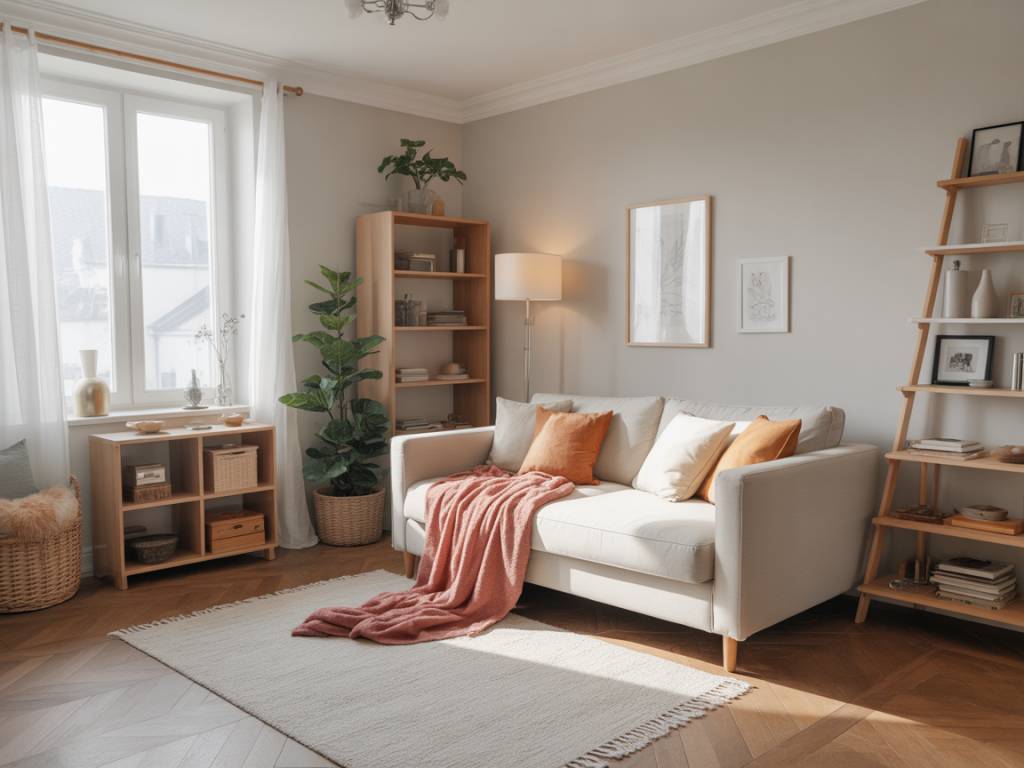
- One sofa with two textured cushions and a heavy throw.
- A wooden coffee table with a single tray: remote, candle, one book.
- A rug that defines the seating area and absorbs sound.
- One floor lamp and one table lamp, both with warm bulbs.
- A low TV unit with closed doors; inside: game controllers, chargers, documents in boxes.
- On the wall: two framed prints you actually love.
No piles of magazines, no cables in sight, but also no sterile emptiness. You can sit, put your feet up, spill a bit of popcorn and not feel like you’re desecrating a museum.
Bedroom
- A simple bed with quality, neutral bed linen and one textured blanket.
- Two small bedside tables with a lamp and maybe a book each, nothing more.
- Inside the wardrobe: clothes edited to what you wear, organised by type.
- A laundry basket with a lid so you don’t see the pile.
The room looks intentionally calm, but not boring: maybe the blanket is a deep colour, or there’s a single photo above the headboard.
Kitchen
- Clear worktops, except for the appliances you use daily (kettle, coffee machine, toaster).
- Items grouped by function in cupboards: baking, breakfast, spices.
- Open shelves, if any, limited to what you enjoy seeing: a few mugs, a plant, a jar of oats.
It’s not a showroom; you can cook a messy meal. But when you’re done, everything has a logical place to go back to.
The main difference with stereotypical minimalism: nothing fragile about living here. The comfort is built-in, not added later as an afterthought.
Where to start tonight (without buying anything)
If you’re tempted to open an e-commerce tab for new boxes and baskets, resist for 24 hours. Start with what you already have and focus on actions, not purchases.
- Choose one room where you spend the most time (often the living room or bedroom).
- Do a 15-minute “comfort audit”: what helps you relax here? What irritates you?
- Clear one surface (coffee table, TV unit, bedside table). Put everything that doesn’t absolutely need to be there in a temporary box.
- Reintroduce only what serves a purpose: light, drink, reading, one decorative piece you love.
- Adjust lighting: if you only have a ceiling light, bring a spare lamp from another room and test the change tonight.
Live with that for a few days. Notice how you move, what you miss, what you don’t. Then repeat, piece by piece, room by room.
A minimalist home that keeps its warmth and personality isn’t built in a weekend and doesn’t rely on buying “minimalist” furniture. It’s the result of hundreds of small, concrete decisions aligned with one question: “Does this make my daily life easier and more pleasant?” If the answer is yes, it has its place. If not, you won’t miss it for long.
À propos de l'auteur