


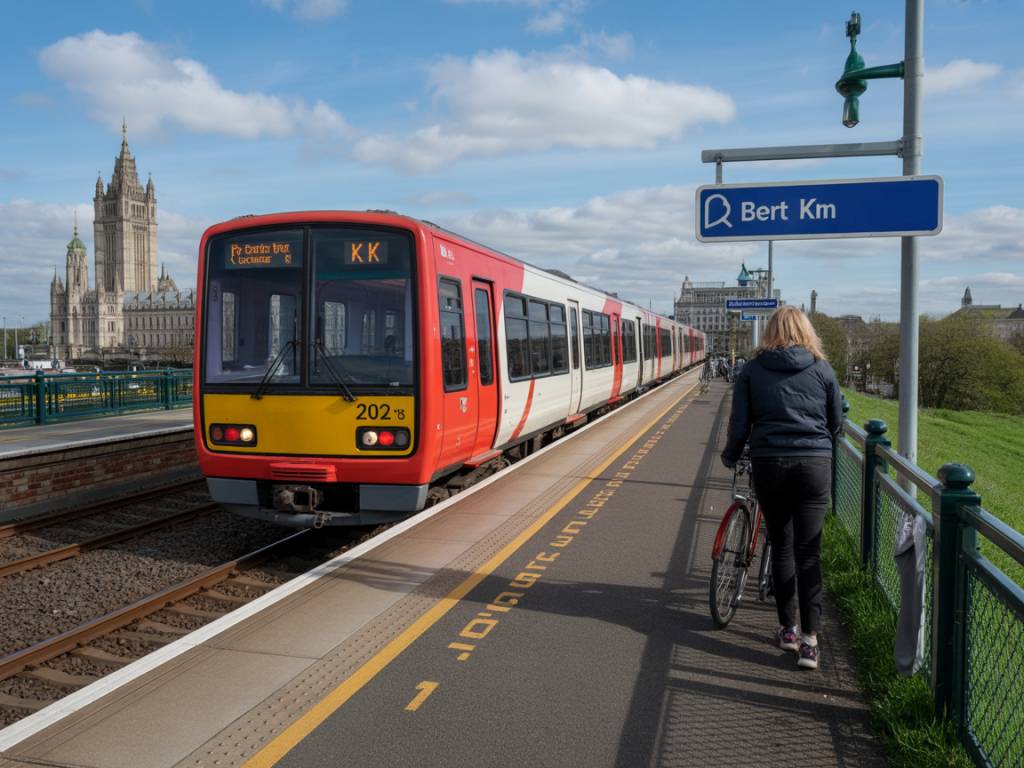
Travelling “more sustainably” in the UK can sound like a vague moral objective. In practice, it often se résume à une question très simple : how do you get from A to B with less carbon, less stress, and ideally, less cost?
Four options reviennent systématiquement : train, coach, bike and walking. None of them is perfect, all of them have trade-offs. But used intelligently — and combinés entre eux — they can dramatically reduce your footprint without turning every trip into an endurance challenge.
Here’s a practical guide, UK-focused, with concrete tips, price ranges and tools you can actually use.
Why bother? (The impact in real numbers)
Before diving into trains and pedals, a quick benchmark. According to data used by the UK Department for Transport and the Rail Delivery Group, average emissions per passenger-km look roughly like this:
- Domestic flights: ~ 254 g CO₂e per passenger-km
- Car (single occupant): ~ 170 g CO₂e
- Coach: ~ 27 g CO₂e
- Rail: ~ 35–45 g CO₂e (varies by route and load)
- Cycling & walking: effectively near-zero (ignoring extra snacks)
No surprise: swapping a domestic flight or solo car journey for train or coach already divides your impact by a factor of 3 to 10. Add biking or walking for the “last mile”, and your trip becomes one of the cleanest options available — sans passer vos vacances à culpabiliser.
Travelling more sustainably by train
The UK rail network is imperfect (you know), but it’s still one of the most efficient ways to cross the country with a relatively low footprint.
To make it truly sustainable, you need to optimise three things: emissions, price, and the overall hassle factor.
Choose trains over planes for internal UK journeys
Simple rule: if your journey is under 5–6 hours by train, question the plane. Typical examples:
- London–Manchester: ~2 hours by train vs ~3–4 hours door-to-door by air (airport transfer + security)
- London–Edinburgh: ~4.5–5 hours by train vs ~3–4 hours by air door-to-door
- London–Glasgow: ~4.5–5.5 hours by train
Factor in Wi-Fi, the ability to work, no baggage drama, and a footprint way below a domestic flight, and the equation flips assez vite en faveur du rail.
Cut your rail emissions further
Not all train routes are equal. Some are fully electrified, others still run diesel trains.
- Prefer electrified mainlines when you have a choice (e.g. East Coast Main Line: London–York–Edinburgh, West Coast Main Line: London–Birmingham–Manchester–Glasgow).
- Travel off-peak: more empty seats mean higher emissions per passenger; fuller trains use capacity better.
- Book direct where possible: fewer changes often mean fewer duplicated engine-hours and shorter routes.
You won’t always have the luxury of choosing, but when you do, those small decisions s’additionnent.
Pay less for sustainable train journeys
Yes, UK trains can be expensive. But if you always buy “Anytime” tickets at the station, that’s not sustainability’s fault — that’s a budgeting problem.
- Get a Railcard if you qualify (16–25, 26–30, Two Together, Senior, Family & Friends, Network Railcard in the South East). They typically cost around £30/year and cut one-third off most fares.
- Book early on long-distance routes (LNER, Avanti West Coast, GWR, etc.). Advance tickets can be dramatically cheaper than walk-up fares.
- Use split-ticketing tools (e.g. Trainline’s split feature, Split My Fare, Railboard) which automatically break your journey into cheaper segments without you leaving the train.
- Compare slower routes: sometimes adding 30 minutes and using a regional operator lowers both price and your share of emissions if the train is better loaded.
Price is the argument le plus souvent brandi contre les transports “verts”. In the UK, it’s often a question of strategy rather than inevitability.
Crossing the UK by coach: low-cost, low-carbon
Coaches aren’t glamorous, but in emission per passenger, they’re among the cleanest motorised options. They’re also often cheaper than trains, sometimes cheaper than driving.
When does a coach beat a train?
Coaches make a lot of sense in three scenarios:
- Long routes where trains are fragmented or pricey (e.g. London–Cornwall, Birmingham–Aberdeen).
- Night journeys (e.g. London–Edinburgh by overnight coach – you save one hotel night and one flight).
- Point-to-point tourist routes where coach operators offer direct services that trains don’t.
Major operators like National Express and Megabus desservent un large réseau, including secondary cities and airports.
Make coaches more bearable (and productive)
To turn a coach trip from “cheap necessity” into “reasonable choice”, work on comfort and scheduling.
- Choose overnight for long distances: board late evening, arrive early morning, save daytime hours.
- Pack noise-cancelling headphones, eye mask and a neck pillow: tiny investments, big difference in perceived quality.
- Download content offline (videos, podcasts, documents) in case on-board Wi-Fi is patchy or absent.
- Book early and pick your seat on services that allow it — front rows or mid-coach are usually quieter and smoother.
Is it as comfortable as a train? No. But in emissions per pound spent, it’s hard to beat.
Cycling: the ultimate flexible, low-cost connector
Cycling isn’t just for Sunday rides in the park. In the UK, it can be a powerful piece of your intercity travel puzzle — especially when combined with trains and coaches.
Use the National Cycle Network intelligently
Sustrans maintains the National Cycle Network, covering thousands of miles of routes across the UK.
- Plan routes on Sustrans’ map or apps like Komoot / Ride with GPS to avoid dangerous A-roads.
- Look for traffic-free sections (canals, old railway lines) which are ideal if you’re not a confident rider.
- Use cycling for the “last 5–15 km” between a rural station/coach stop and your final destination (campsite, B&B, small village).
You don’t need to be a lycra-clad athlete to benefit; an e-bike or even a folding bike opens a lot of options, especially in hilly regions.
Take your bike on trains and coaches (without losing your sanity)
Mixing bike and public transport is where sustainable travel devient vraiment puissant — but the rules are messy.
- Trains:
- Most UK trains allow a limited number of bikes.
- Long-distance services (LNER, GWR, Avanti, ScotRail) often require advance reservations for full-size bikes.
- Folding bikes are usually allowed anytime, no booking, as luggage.
- Coaches:
- Some operators accept bikes in luggage compartments if they’re boxed or bagged, but it’s not guaranteed.
- Always check the operator’s policy and, if possible, call ahead.
If you intend to travel regularly, a folding bike (Brompton style or equivalent) is often the most practical and flexible choice in the UK system.
Stay safe and visible
On UK roads, the main sustainable risk is not carbon — it’s traffic. A few essentials:
- Lights front and rear, even in summer; many trips end later than prévu.
- High-visibility elements (vest, reflective strips) if you’ll be on rural or unlit roads.
- Basic lock so you can leave the bike at a station or coach stop without stress.
- A small repair kit (inner tube, tyre levers, mini-pump) to avoid being stuck in the middle of nowhere.
Sustainability includes your personal safety. An extra 300 g of gear is a low price to pay to avoid a night walk on a B-road without pavement.
Walking: turning travel into part of the trip
Walking is the zero-emission cliché, but in the UK it can be more than a nice idea. Between the England Coast Path, the South West Coast Path, the West Highland Way or the Hadrian’s Wall Path, you can literally cross entire regions on foot — with public transport at both ends.
Use rail and coach to reach long-distance trails
Most iconic walking routes start and end near villages served by trains or buses. For example:
- Hadrian’s Wall Path: access via Newcastle or Carlisle by rail, then local buses.
- South Downs Way: reachable from Brighton, Eastbourne or Winchester — all served by trains.
- West Highland Way: starts in Milngavie, accessible by train from Glasgow.
Instead of driving to a trailhead, parking, and then worrying about how to get back to your car, you can:
- Arrive by train or coach.
- Walk your route over several days.
- Return from the other end by public transport.
Less admin, less cost, practically zero carbon.
Lighten your load, increase your range
For multi-day walks, weight is your biggest enemy, not distance. Sustainable walking travel is about realistic packing:
- Limit yourself to a 30–40L backpack for 3–5 days; beyond that, you’re probably overpacking.
- Use accommodation en route (hostels, B&Bs, campsites) instead of carrying a full camping setup every time.
- Carry layers, not bulk: a good waterproof shell + mid-layer covers most UK weather combos.
- Refill water and buy food locally instead of carrying it all from home; this also supports local economies.
Walking with half your bodyweight on your back is not heroic — it’s just a reliable way to hate the experience.
Combining modes: the real sustainability advantage
The most efficient UK trips — in both carbon and cost — rarely rely on one single mode. They combine train, coach, bike and walking according to distance and context.
Think in “legs”, not single journeys
Take a typical scenario: you live in London and want a low-carbon long weekend hiking in the Lake District.
- Leg 1: London to Oxenholme by train (fast, relatively low-carbon).
- Leg 2: Oxenholme to Windermere by local train/bus.
- Leg 3: Walk or cycle between villages, using local buses where needed.
- Leg 4: Return the same way, with flexibility on the final coach/train depending on weather.
Swap Lake District for Cornwall, the Highlands or the Peak District, and the logic is the same: fast low-carbon mode for the long leg, slower or active modes for the last miles.
Use the right planning tools
You don’t need twenty tabs open and three guidebooks. A few tools couvrent 90% des besoins :
- National Rail Enquiries / Trainline / rail operator apps for train schedules and prices.
- Rome2Rio to see combined route options (train + bus + coach).
- Google Maps / Citymapper for local public transport and walking/cycling routes in cities.
- Komoot / OS Maps for hiking and cycling routes off-road, with elevation profiles.
Spend 20 minutes planning once, save hours and emissions repeatedly.
Reduce your footprint further without overcomplicating things
Once you’ve chosen low-carbon modes, the rest is optimisation, not obsession. A few levers:
- Travel less often, but longer: instead of three short, flight-heavy weekends, do one week-long trip mostly by train/coach.
- Choose accommodation that doesn’t require a car: stay near town centres or transport hubs so you can walk or cycle.
- Eat and shop local: if your travel is low-carbon but everything you consume is shipped from overseas, the global picture is less impressive.
- Pack reusable basics (water bottle, small coffee cup, cutlery) to cut single-use waste en route.
The objective is not to reach theoretical perfection, but to divide your impact by 2, 3 or 4 compared to the classic “car + plane” model — consistently.
What about time — does sustainable mean slower?
Sometimes, yes. Often, not as much as you think.
If you compare pure in-vehicle times, planes can look faster. But add:
- Transport to a distant airport.
- Security queues and waiting time.
- Boarding and disembarking delays.
- Transport from the arrival airport to the city centre.
Then compare that to a city-centre-to-city-centre train with minimal faff, where you can work, read or sleep. In many UK cases, the total door-to-door difference is less dramatic than the marketing suggests.
And when you’re on a coach, bike or foot, a part of the journey becomes usable time — to read, listen to something, or actually see the country you’re crossing instead of clouds and duty-free.
Starting small: practical first steps
If your current baseline is “car or plane for everything”, you don’t need to become a multi-modal logistics genius overnight. Three simple moves will already shift your travel profile:
- Replace one domestic flight this year with a train or coach — London–Edinburgh, Manchester–London, Bristol–Glasgow, etc.
- Add cycling or walking for all journeys under 3 km at destination — station to hotel, hotel to venue, seaside walks instead of short drives.
- Plan one trip built entirely around public transport + walking — a weekend hiking route accessible by train and bus.
You’ll identify your personal constraints (budget, time, comfort threshold) and can adjust from there — but with concrete experience, not just theory.
Sustainable travel isn’t about punishment or purity tests. It’s about using the UK’s existing network — trains, coaches, bikes, paths — à votre avantage, to travel further with less cost, less carbon and, quite often, a much better story to tell when you’re back.